
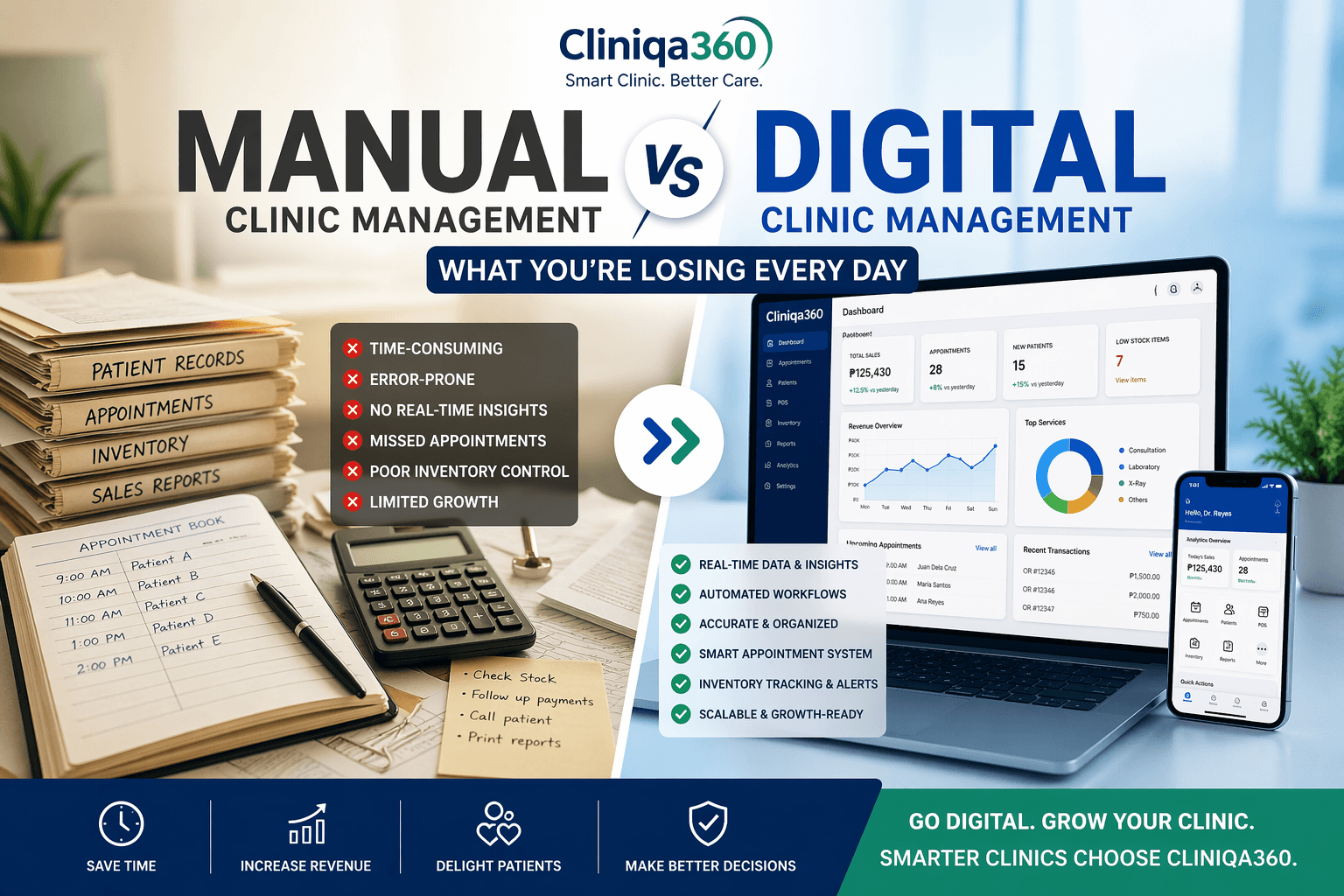
Introduction: The Daily Struggle Most Clinics Don’t Talk About
You open your clinic.
The day starts with checking appointments—written in a notebook or scattered across messages.
A patient arrives. Staff scramble to find records.
Inventory? Someone “thinks” there’s still stock.
At the end of the day, you ask:
“How much did we actually earn today?”
No clear answer.
This is the reality of manual clinic management.
And here’s the problem:
👉 It feels normal—but it’s silently costing you time, money, and growth.
⚡ Quick Answer (FEATURED SNIPPET)
Manual vs digital clinic management refers to the difference between running clinic operations using paper-based or disconnected tools versus using an integrated software system. Digital clinic management improves efficiency, reduces errors, provides real-time insights, and automates workflows—helping clinics save time, increase revenue, and deliver better patient experiences.
🧠 What is Manual vs Digital Clinic Management?
Manual Clinic Management
This involves:
- Paper records
- Spreadsheets
- Manual scheduling
- Physical inventory tracking
👉 Everything depends on people and memory.
Digital Clinic Management
This uses a clinic management system to:
- Automate workflows
- Centralize data
- Provide real-time insights
👉 Everything is connected, trackable, and scalable.
📊 Why This Matters More Than You Think
The difference isn’t just convenience.
It’s business survival.
Clinics using manual systems often face:
- Slower operations
- Higher error rates
- Limited scalability
Clinics using digital systems:
- Operate faster
- Make better decisions
- Grow more consistently
👉 In 2026, digital is no longer optional—it’s a competitive advantage.
⚠️ Key Problems with Manual Clinic Management
1. ❌ Time-Consuming Processes
Every task takes longer:
- Searching patient records
- Writing appointments
- Computing totals manually
👉 Time lost = fewer patients served
2. 📉 Lack of Real-Time Visibility
You don’t know:
- Daily revenue
- Inventory levels
- Patient trends
👉 Decisions become guesswork
3. 🧾 High Risk of Errors
Manual processes lead to:
- Incorrect billing
- Missing records
- Inventory mistakes
4. 📅 Scheduling Conflicts
Manual booking often results in:
- Double bookings
- Missed appointments
👉 Lost revenue + frustrated patients
5. 📦 Poor Inventory Control
Without tracking:
- Stockouts happen
- Expired items go unnoticed
6. 🧠 Overdependence on Staff
When knowledge isn’t centralized:
- Operations depend on specific people
- Mistakes increase when staff changes
🚀 Advantages of Digital Clinic Management
1. ⚡ Faster Operations
Everything is accessible instantly:
- Patient records
- Appointments
- Transactions
2. 📊 Real-Time Insights
You can see:
- Daily revenue
- Top services
- Patient trends
👉 Better decisions, faster
3. 🔄 Automation
Automate:
- Appointment scheduling
- Billing
- Notifications
👉 Less manual work, more efficiency
4. 📈 Better Patient Experience
- Faster service
- Accurate records
- Organized scheduling
5. 📦 Smart Inventory Management
- Real-time stock tracking
- Low-stock alerts
👉 No more guesswork
6. 🏢 Scalability
Digital systems grow with your clinic:
- Add branches
- Manage everything in one dashboard
🆚 Manual vs Digital Clinic Management (Quick Comparison)
FeatureManualDigital
Speed
Slow
Fast
Accuracy
Error-prone
High accuracy
Data Access
Limited
Real-time
Scalability
Difficult
Easy
Automation
None
Full
Insights
None
Data-driven
🧩 How Cliniqa360 Solves This
Instead of juggling multiple tools—or relying on manual systems—Cliniqa360 provides:
- POS system for real-time transactions
- Inventory tracking with alerts
- Patient management with centralized records
- Appointment scheduling system
- Reporting dashboard with analytics
- AI-powered insights and forecasting
- Multi-branch management
👉 It transforms your clinic into a fully digital operation
🏥 Real-World Scenario
Before (Manual):
- Staff manually check appointments
- Inventory is guessed
- Revenue is unclear
After (Digital with Cliniqa360):
- Appointments are automated
- Inventory is tracked in real time
- Revenue dashboard updates instantly
👉 Result:
- Faster operations
- Fewer errors
- Higher revenue
📌 Key Takeaways
- Manual systems slow down clinic growth
- Digital systems improve efficiency and accuracy
- Automation reduces workload
- Data enables better decisions
- Digital transformation is essential in 2026
🚀 Conclusion: The Shift is Already Happening
The question isn’t:
“Should I go digital?”
The real question is:
“How much longer can I afford to stay manual?”
Clinics that switch early:
- Save time
- Increase revenue
- Deliver better care
👉 Call to Action
If you’re ready to upgrade your clinic:
- Try Cliniqa360
- Experience automation
- Take full control of your operations
❓ FAQ Section
1. What is the difference between manual and digital clinic management?
Manual management uses paper and manual processes, while digital management uses software to automate and centralize clinic operations.
2. Why should clinics switch to digital systems?
Digital systems improve efficiency, reduce errors, and provide real-time insights for better decision-making.
3. Is digital clinic management expensive?
Many modern systems are affordable and provide ROI through improved efficiency and revenue tracking.
4. Can small clinics benefit from digital systems?
Yes, small clinics benefit the most by saving time and improving organization.
5. How do I start digitizing my clinic?
Start by adopting a clinic management system that integrates scheduling, billing, inventory, and patient records.